Excited about AI? Concerned about AI? Ask yer questions here! Get yer AI answers here (maybe)! If you want my creds in the space, google david+shive+gsa+ai. Opinions are my own.
I think AI has it’s uses and is a great thing and great development for the human race.
Unfortunately, our “overlords” (Musk, Bezos, Thiel etc) only see it as a tool to get rid of us pesky workers. And how about those environmental issues? Datacenters sucking up all the power and water, all for the profit of the 1%. No model of AI is meant to do anything but increase profits for an ever shrinking class of people and send the rest of us to bread lines.
The good versions of these LLMs are astonishingly capable. There have been a number of longstanding unproven conjectures in advanced math that have either been proven or falsified by Claude, GPT, etc. It’s really remarkable. There are kinds of thinking they’re better at and kinds of thinking they’re not so good at, and we’re all left wondering how that’ll shake out for us.
Before getting into whether they are “thinking,” I’m happy to fall back on the decades-old quote from Edsger Dijkstra that asking whether computers can think is “just as meaningful as the question whether submarines can swim.”
The power grid concerns are legitimate, especially inasmuch as more consumption requires us burning more fossil fuels.
The water usage concerns are wildly overblown and effectively a non-concern.
The economic concerns with respect to capital allocation (investment bubble, etc) seem perfectly legitimate to me, especially given that if cheaper open-weight models remain competitive, we’re probably going to see a lot of shareholder value detonate and its ashes will fall on all of us.
As to the labor market concerns—are we all getting put out of work, as so many AI execs seem to want to convince us—I really don’t know what to think. Many fields are obviously going to be upended. The more immediate concern for a lot of us may be the job market fallout from a bubble popping. But if the models continue to improve (and I think they will), it’s very hard to picture what the future of white-collar work looks like.
The Goldilocks scenario seems to be that the tech works and we as a species get a great new tool, but that the tech remains expensive enough that it doesn’t cause the widespread labor market upheaval people speculate about.
ETA: the other day I saw a woman wearing a shirt that said “if you talk to me about AI I will kill myself.” I thought it was hilarious, if inappropriate for the setting, but I think an awful lot of us share that sentiment to some extent. The AI companies and executives across many industries should consider why jokes like that land with so many people.
My concern with AI is that I don’t believe that every word uttered in the office, on any subject, at any time, should be recorded and run through AI for “clarity”, “summary”, “interpretation”, and “documentation”. Especially when it concerns how we may have fucked something up.
I am not losing a lot of sleep over how it affects people whose brains are more or less finished developing. I am much more concerned about its impact on the young and therefore the future. The personal computing revolution has pretty much completely trashed education in this country and AI is expanding that shock wave deep into the personal lives of people whose brains are still mostly puddles.
If you are not concerned about general literacy and reading comprehension, I don’t know what to say.
I am cautiously pessimistic about Generative AI, which is very, very different than the traditional machine learning / natural language processing / predictive AI variants. The unchecked, high velocity, high iteration environment we are in right now is risky, to the point of being dangerous. The controls managing industry advancements (and subsequent releases) are not aligned with the actual risk. That coupled with the market-share grab underway is leading to unnecessarily risky behaviors. On both sides of the ledger.
The technology is truly spectacular and the advancement velocity in the underlying tech (the models) is breathtaking. The advancement velocity of all things that touch or are impacted by the tech will be equally breathtaking. In the same way that the world is a completely different place than it was 25 years ago (in how we do business, how we interact with other humans, how we minimize and augment human frailties, how we entertain ourselves, how we educate ourselves, etc…), this technology will be just as revolutionary but on much shorter timescales and at much greater impact.
Two main thoughts run through my mind on a regular basis since I have a front row seat to all of this: 1) In the entire course of human history, we humans have been the smartest entity in any capacity, in any dimension in which we operate and navigate. Soon, for the first time in that arc of human history, that will no longer be the case. And, 2) Over the entire arc of world history, a smarter thing has never been subjugated by the less-smart thing for anything other than small blips of time. The smart thing always takes control. Always.
Like any information source, including tech, books, other people, etc…, you have to consider the source and base/generate trust on a number of indicators. And, models trained on discreet, finite sources (like the law) tend to perform very, very well and those trained on dubious sources (like twitter or facebook) tend to perform less well. And, this is a space where you get what you pay for. If you use free models trained on public sources like social media, you’ll get exactly what you expect. No different than asking a 14 year old raised on TikTok to opine on some complex or novel thing.
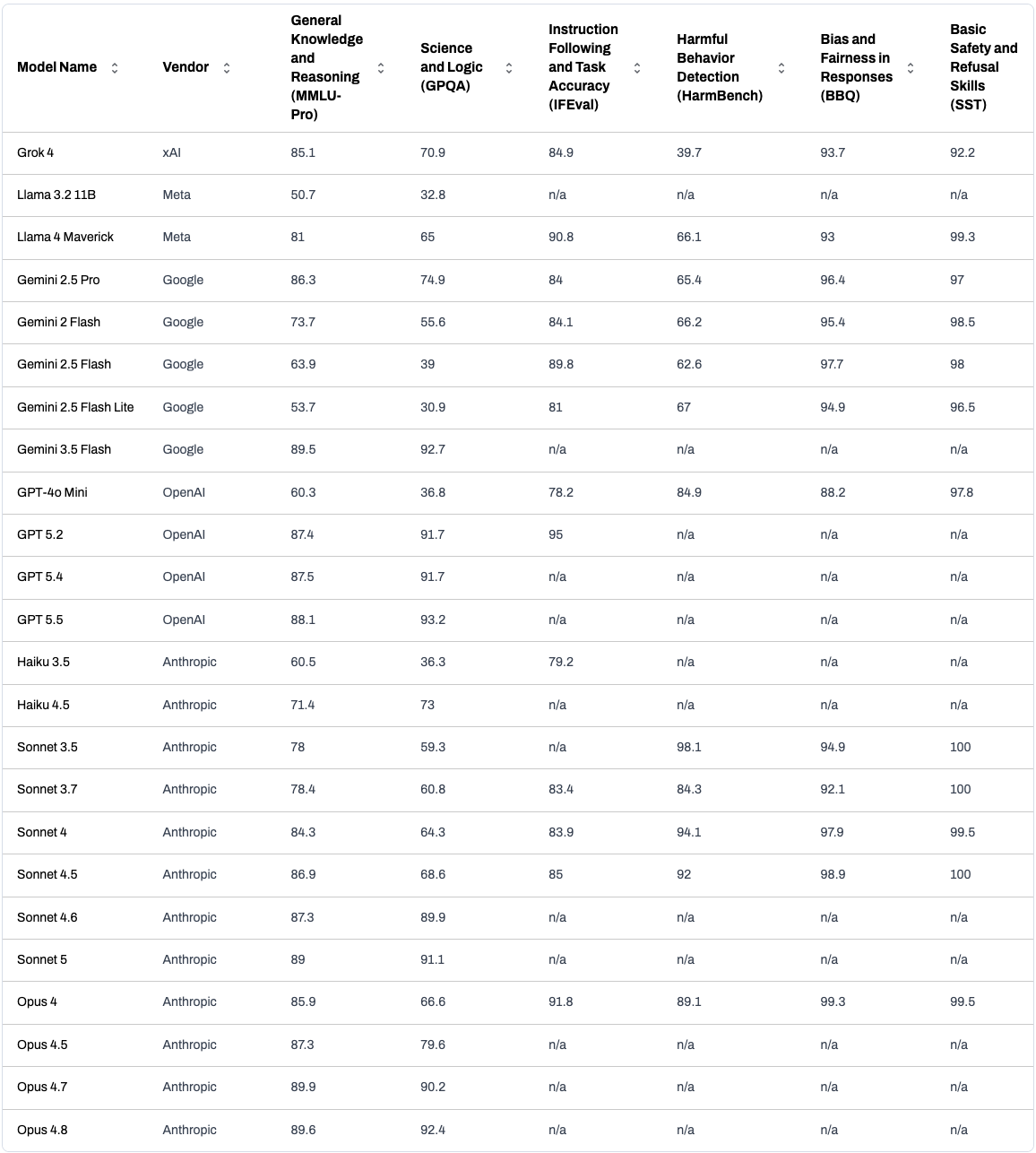
Here’s a table on model effectiveness, from public benchmarks:
For context, to score a 100, the model would have to answer 100% correctly across hundreds of thousand benchmark questions with “correct” defined by panels of domain experts. For perspective, human domain experts with 5-7 years of experience generally score around 85% on these benchmarks. Human domain practitioners with 5-7 years of experience typically score around 70%. All of these number are sharply up over the last 18 months. To the tune of 20+% increases across the board. And, there is no sign of skill slope flattening. For you statisticians out there, let that sink in. What slope shows no real flattening as it nears 100%? That’s right, none. Yet, that’s what we’re seeing as benchmark scores moved from the mid-60’s to mid-80’s over the last 18 months.
I wrote dozens of papers in my high school career.
More than a quarter were for my 11th grade history class.
My kids wrote a total of 2 papers between them in high school. If even that.
Teaching to the test was a thing long before AI and yes I’m worried about it how will further impact the way young people read and write. Or more accurately the way they don’t.
To be clear, I an not an educator and I feel for those that are as they watch the spiral of the current state here in the US. In my moderate sample size of (now 46) kids and seeing successive waves of maybe 3-4,000 incoming staff graduating and entering the STEM workforce over the last 20+ years, I see some nuance and complexity. I see kids–>young adults falling into two camps with sharply less numbers in the middle. On one side is highly motivated learners (motivated by any number of forcing types) that are sharp, eager and high-performing. The numbers are overall down but those higher learners/performers are equal to and probably slightly more capable than their predecessors. Influxes of non-US cultures have probably inflated those numbers of higher performers, muting the losses in the “traditional” multi-generation american groups. The “super smart from this generation” group being slightly “smarter” than previous appears to be technology-enabled. Those with a massive capacity to ingest and process complex information have basically unlimited resources so there is no artificial information-limited cap on their learning. On the other side, the current societal constructs and reliance/addiction to technology promotes and provides opportunity for massive laziness and apathy (plus anxiety and comorbid depression) sucking millions into a learning and productivity abyss that many will never recover from. They are unthoughtful, reactive, entitled and not motivated by traditional constructs of personal or societal worth. They want things easy and to be taken care of and prefer image over substance. And then there is the ever-shrinking middle, which has long been the hallmark of american greatness and enabled by reasonably-well educated masses with an emphasis on innovation and creativity vs. performative scoring.
So, that’s my long, Noe-esque ramble meant to say; I think the lazy, entitled people will probably become even more error prone and fall more readily to the biases of AI, just like they do with social media. I think those in the middle will find life easier and more automated and their “errors” will be muted a bit by reliance on AI as is matures. And, those natural, motivated high-performers will be super-powered by the tech. Creating a new construct of haves and have-not’s since we humans really love organizing ourselves that way.
You can’t help but base your predictions on people who came to AI having already spent time in a non-AI-saturated world. My dad loves Chat, can’t get enough of it. As with middle-aged and older people all over the place, his brain finished developing decades ago. He can incorporate it into his life with relative ease. I suspect much of your anticipated worldview to be nullified by the matriculation of entire generations of people who’ve never had to think for themselves or get through a conversation without coaching or who came of age thanks to fake friends they paid Zuckerburg for.
I don’t understand the mass acceptance that finding life “easier and more automated” is an absolute good. You’ve already stated elsewhere that this revolution will massively accelerate current trends in tech generally–these trends that have obliterated the commons and fracked our attention into dust and set the business of the world safely out of the reach of the people it burns for heat. To which we say, OK, but it makes these reports easier to compile, and I don’t have to write emails anymore, and sometimes it does really amazing math?
This is a crisis moment and we aren’t meeting it. Our systems institutionally and personally have become too compromised to meet it.
Two comments, with the last going first. 1) I never said or suggested any of this is good. We as humans are designed to work and think and it’s well-understood that when we don’t, bad things happen. Physically, emotionally, spiritually and societally. Easier and more automated is just that. Easier and more automated. Neither is likely to lead to good outcomes. And, 2) that anticipated world view is partly informed by what I see from the true digital natives born around and after 2000, the earliest of which are just now completing the development of their frontal cortexes. Like I suspect you see, large swaths are emerging from this developmental phase with almost no ability to strategize, verbalize coherant strategic thinking and little to no ability to anticipate the downstream effects of their current actions. It’s like the use of tech, combined with the current societal constructs have locked them into a perpetual 17-19 year old personal operating model. And, this is all largely before AI. AI will compound this effect, I suppose. It’s alarming.
I work with some of the faculty at the Baylor College of Medicine and it appears to my generally luddite brain that AI can be a fabulous tool for highly technical expert applications in science, engineering, and technology.
But having it lazily vomit out a paper or any attempt to communicate thoughts or ideas is imbecilic, in that it generally sounds dumb, tells you what you want to hear, and turns you into an imbecile because you are outsourcing basic critical thought which is a muscle that only gets stronger by constant exercise.
-Fed it some info about a dispute between my insurer, pharmacy, and the drug manufacturer to have it cut through the ridiculous mess of the health care system to avoid getting stuck with a $2,000 copay (worked like a charm, explained the terminology simply, suggested all the right questions to ask each party)
-Asked it to make an exhaustive list of topics to give advice to a friend who’s got a baby on the way (just the topics as a starting point, for me to fill in the actual details)
I have not found it very useful for work, where my main function is applying professional judgment. I worked with our AI lead to try build a tool for some rote tasks relating to legal document analysis. Not a success.
AI or no AI, the idea of kids not writing papers in schools anymore horrifies me. I wrote more than I can count. (I can’t count very high, that’s why I was a history major.)
In terms of lawyering, the biggest impact I’ve seen has been on the client side. Clients are using LLMs to get a “first pass” understanding of the law or the issues with their case, and then calling us to affirm/deny what Copilot generated. On the one hand, they’re often coming in with a better grasp on some of the fundamentals, and you have to spend less time explaining them, but there’s almost always some misconception that need to be corrected, and usually to the client’s disappointment.
And then that gets followed up with a conversation about how chatting with a third party chatbot could be breaking the attorney-client privilege, meaning that the other side now gets to see your questions and prompts. Fun!
I haven’t found any big gains in day-to-day work because a lot of that is, as you say, applying professional judgment, which these tools simply do not have. As part of testing these tools, we often run work product through a firm-sandboxed tool after humans have completed the initial work. It does catch things from time to time that can easily fly under the radar–things on the level of “this pinpoint citation isn’t correct” or “you should capitalize this word to make it clear you’re using a defined term.” But even then, the one good suggestion is buried in a list of 12 other suggestions that are dumb or counterproductive.
The most useful thing I have seen AI do in my life is help me and my brothers think through the complex issues of having aging parents with health and dementia related issues.
By brother did a great job with the prompts and we found it very helpful to think through the perspectives. For example - when my dad died, navigating that with mom’s dementia was very difficult.
The suggestions and feedback were point on and helped us navigate a tough situation.
Sign on the door informing well wishers of mom’s memory and gave them guidance if she mentioned that dad wasn’t dead.
Made us aware that most of the emotional pain with having to tell her dad was dead was on our end, not on her end.
How to handle phone / facebook as people reach out to her.
My brother’s best prompt was to pose a question to Claude and ask it to give us guidance from a multidisciplinary team. We felt much more confident and comfortable choosing a way forward.
I’m seeing the other side of that coin. Being in-house in a consumer-facing business, complaints and demand letters are now much wordier and better versed in the law. People come back time and again with lengthy legal arguments with very little basis in fact. It’s like everyone now has a debate-kid lawyer who knows all about the law and wants you to know it, but takes everything their client says at face value without probing the facts. And if their client says “write an argument in reply to the company’s response,” by god, ChatGPT is going to do it. A lawyer would tell them when the battle is lost.